
• Home /
  • Solution /
  • Writing /
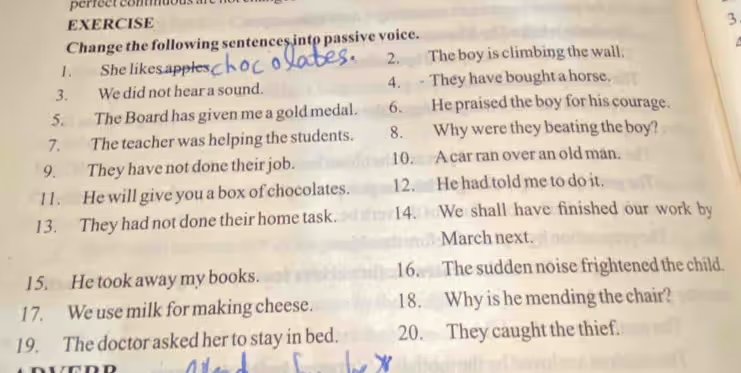
  • EXERCISE Change the following sentences into passive voice. 1. She likes chocolates. 2. The boy is climbing the wall. 3. We did not hear a sound. 4. They have bought a horse. 5. The Board has given me a gold medal. 6. He praised the boy for his courage. 7. The teacher was helping the students. 8. Why were they beating the boy? 9. They have not done their job. 10. A car ran over an old man. 11. He will give you a box of chocolates. 12. He had told me to do it. 13. They had not done their home task. 14. We shall have finished our work by March next. 15. He took away my books. 16. The sudden noise frightened the child. 17. We use milk for making cheese. 18. Why is he mending the chair? 19. The doctor asked her to stay in bed. 20. They caught the thief.

EXERCISE Change the following sentences into passive voice. 1. She likes chocolates. 2. The boy is climbing the wall. 3. We did not hear a sound. 4. They have bought a horse. 5. The Board has given me a gold medal. 6. He praised the boy for his courage. 7. The teacher was helping the students. 8. Why were they beating the boy? 9. They have not done their job. 10. A car ran over an old man. 11. He will give you a box of chocolates. 12. He had told me to do it. 13. They had not done their home task. 14. We shall have finished our work by March next. 15. He took away my books. 16. The sudden noise frightened the child. 17. We use milk for making cheese. 18. Why is he mending the chair? 19. The doctor asked her to stay in bed. 20. They caught the thief.

EXERCISE Change the following sentences into passive voice. 1. She likes chocolates. 2. The boy is climbing the wall. 3. We did not hear a sound. 4. They have bought a horse. 5. The Board has given me a gold medal. 6. He praised the boy for his courage. 7. The teacher was helping the students. 8. Why were they beating the boy? 9. They have not done their job. 10. A car ran over an old man. 11. He will give you a box of chocolates. 12. He had told me to do it. 13. They had not done their home task. 14. We shall have finished our work by March next. 15. He took away my books. 16. The sudden noise frightened the child. 17. We use milk for making cheese. 18. Why is he mending the chair? 19. The doctor asked her to stay in bed. 20. They caught the thief.

Answer

The image contains an English grammar exercise, not a mathematical problem. The task is to change sentences from active to passive voice. Here’s how you can approach it:

Answer: Here are the passive voice conversions for some sentences:

  1. Chocolates are liked by her.
  2. The wall is being climbed by the boy.
  3. A sound was not heard by us.
  4. A horse has been bought by them.

Explanation: In English grammar, converting a sentence from active to passive voice involves making the object of the active sentence the subject of the passive sentence. The verb form changes to accommodate this shift, often using a form of “to be” plus the past participle of the main verb.

Steps:

  1. Identify the Subject, Verb, and Object:
  • Active: “She likes chocolates.”
  • Subject: She
  • Verb: likes
  • Object: chocolates
  1. Rearrange to Passive:
  • Make the object the new subject: “Chocolates”
  • Use the appropriate form of “to be”: “are”
  • Use the past participle of the main verb: “liked”
  • Add “by” and the original subject: “by her”
  1. Construct the Passive Sentence:
  • Passive: “Chocolates are liked by her.”

Repeat these steps for each sentence to convert them from active to passive voice.

Related

(2) O3 + H → O2 + OH k2 = 1.78×10^-11 cm^3 s^-1 (3) O + OH → O2 + H k3 = 4.40×10^-11 cm^3 s^-1 (5) O + HO2 → O2 + OH k5 = 3.50×10^-11 cm^3 s^-1 (6) H + HO2 → O2 + H2 k6 = 5.40×10^-12 cm^3 s^-1 (9) OH + HO2 → O2 + H2O2 k9 = 4.00×10^-11 cm^3 s^-1 (10) HO2 + HO2 → O2 + H2O2 k10 = 2.50×10^-12 cm s^-1 (11) O + O2 + M → O3 + M k11 = 1.05×10^-34 cm^6 s^-1 (14) H + O2 + M → HO2 + M k14 = 8.08×10^-32 cm^6 s^-1 (15) H + H + M → H2O + M k15 = 3.31×10^-27 cm^6 s^-1 (16) O2 + hv → 2 O k16 = (1.26×10^-8 s^-1) φ (17) H2O + hv → H + OH k17 = (3.4×10^-6 s^-1) φ (18) O3 + hv → O2 + O k18 = (7.10×10^-5 s^-1) φ

Table 1 Reactions, rate constants and activation energies used in the model* No. Reaction kopt (M⁻¹ s⁻¹) 1 OH + H₂ → H + H₂O 3.74 x 10⁷ 2 OH + HO₂ → HO₂ + OH⁻ 5 x 10⁹ 3 OH + H₂O₂ → HO₂ + H₂O 3.8 x 10⁷ 4 OH + O₂ → O₂ + OH 9.96 x 10⁹ 5 OH + HO₂ → O₂ + H₂O 7.1 x 10⁹ 6 OH + OH → H₂O₂ 5.3 x 10⁹ 7 OH + e⁻aq → OH⁻ 3 x 10¹⁰ 8 H + O₂ → HO₂ 2.0 x 10¹⁰ 9 H + HO₂ → H₂O₂ 2.0 x 10¹⁰ 10 H + H₂O₂ → OH + H₂O 3.44 x 10⁷ 11 H + OH → H₂O 1.4 x 10¹⁰ 12 H + H → H₂ 1.94 x 10¹⁰ 13 e⁻aq + O₂ → O₂⁻ 1.9 x 10¹⁰ 14 e⁻aq + O₂ → HO₂⁻ + OH⁻ 1.3 x 10¹⁰ 15 e⁻aq + HO₂ 2.0 x 10¹⁰ 16 e⁻aq + H₂O₂ 1.1 x 10¹⁰ 17 e⁻aq + HO₂ → OH + OH⁻ 1.3 x 10¹⁰ 18 e⁻aq + H⁺ → H 2.3 x 10¹⁰ 19 e⁻aq + e⁻aq → H₂ + OH⁻ + OH⁻ 2.5 x 10⁹ 20 HO₂ + O₂ → O₂ + HO₂ 1.3 x 10⁹ 21 HO₂ + HO₂ → O₂ + H₂O₂ 8.3 x 10⁵ 22 HO₂ + HO₂ → O₂ + OH + H₂O 3.7 23 HO₂ + HO₂ → O₂ + O₂ + OH + H₂O 7 x 10⁵ s⁻¹ 24 H⁺ + O₂⁻ → HO₂ 4.5 x 10¹⁰ 25 H⁺ + O₂⁻ → O₂ 2.0 x 10¹⁰ 26 H⁺ + OH⁻ 1.4 x 10¹¹ 27 H⁺ + HO₂⁻ 2 x 10¹⁰ 28 H₂O₂ → HO₂ + H⁺ + OH⁻ 2.5 x 10⁻⁵ s⁻¹ 29 H₂O₂ → H⁺ + OH⁻ 1.4 x 10⁻⁷ s⁻¹ 30 O₂ + O₂ → O₂ + HO₂ + OH⁻ 0.3 31 O₂ + H₂O₂ → O₂ + OH + OH 16 32

(2) O3 + H → O2 + OH k2 = 1.78×10^-11 cm^3 s^-1 (3) O + OH → O2 + H k3 = 4.40×10^-11 cm^3 s^-1 (5) O + HO2 → O2 + OH k5 = 3.50×10^-11 cm^3 s^-1 (6) H2O + O → 2 OH k6 = 5.40×10^-12 cm^3 s^-1 (9) OH + HO2 → O2 + H2O k9 = 4.00×10^-11 cm^3 s^-1 (10) HO2 + HO2 → O2 + H2O2 k10 = 2.50×10^-12 cm s^-1 (11) O + O2 + M → O3 + M k11 = 1.05×10^-34 cm^6 s^-1 (14) H + O2 + M → HO2 + M k14 = 8.08×10^-32 cm^6 s^-1 (15) OH + H + M → H2O + M k15 = 3.31×10^-27 cm^6 s^-1 (16) O2 + hv → 2 O k16 = (1.26×10^-8 s^-1) φ (17) H2O + hv → H + OH k17 = (3.4×10^-6 s^-1) φ (18) O3 + hv → O2 + O k18 = (7.10×10^-8 s^-1) φ

Table 1 Reactions, rate constants and activation energies used in the model* No. Reaction kopt (M−1 s−1) 1 OH + H2 → H + H2O 3.74 x 10⁷ 2 OH + HO2 → HO2 + OH− 5 x 10⁹ 3 OH + H2O2 → HO2 + H2O 3.8 x 10⁷ 4 OH + O2 → O2− + OH 9.96 x 10⁹ 5 OH + HO2 → O2 + H2O 7.1 x 10⁹ 6 OH + OH → H2O2 5.3 x 10⁹ 7 OH + eaq− → OH− 3 x 10¹⁰ 8 OH + O2− → HO2 2.0 x 10¹⁰ 9 H + O2 → HO2 2.0 x 10¹⁰ 10 H + HO2 → H2O2 2.0 x 10¹⁰ 11 H + H2O2 → OH + H2O 3.4 x 10⁷ 12 H + OH → H2O 1.4 x 10¹⁰ 13 H + H → H2 7.9 x 10⁹ 14 eaq− + O2 → O2− 1.94 x 10¹⁰ 15 eaq− + O2− → HO2− + OH− 1.3 x 10¹⁰ 16 eaq− + HO2 → OH− + OH 2.5 x 10¹⁰ 17 eaq− + H2O2 → OH + OH− 1.3 x 10¹⁰ 18 eaq− + H → H− 2.5 x 10¹⁰ 19 eaq− + eaq− + H2 + OH− 3.5 x 10⁹ 20 eaq− + H2O2 + OH− 4.5 x 10⁹ 21 HO2 + O2 → O2 + HO2 3.7 22 HO2 + HO2 → O2 + H2O2 3.7 23 HO2 + HO2 → O2 + OH + H2O 7 x 10⁵ s−1 24 HO2− + O2 4.5 x 10¹⁰ 25 H2O2 → 2OH 0.035 s−1 26 H+ + O2− → HO2 2 x 10¹⁰ 27 H+ + HO2− → HO2 2 x 10¹⁰ 28 H2O2 → H+ + HO2− 2.5 x 10⁻⁵ s−1 29 H2O2 → H+ + HO2− 2.5 x 10⁻⁵ s−1 30 O2− + O2 → HO2 + OH− 0.3 31 O2− + H2O2 → O2 + OH− + OH 16 32 1.8 x 10⁷

(2) O3 + H → O2 + OH k2 = 1.78×10^-11 cm^3 s^-1 (3) O + OH → O2 + H k3 = 4.40×10^-11 cm^3 s^-1 (5) O + HO2 → O2 + OH k5 = 3.50×10^-11 cm^3 s^-1 (6) H2O → O + H2 k6 = 5.40×10^-12 cm^3 s^-1 (9) OH + HO2 → O2 + H2O k9 = 4.00×10^-11 cm^3 s^-1 (10) HO2 + HO2 → O2 + H2O2 k10 = 2.50×10^-12 cm s^-1 (11) O + O2 + M → O3 + M k11 = 1.05×10^-34 cm^6 s^-1 (14) H + O2 + M → HO2 + M k14 = 8.08×10^-32 cm^6 s^-1 (15) OH + H + M → H2O + M k15 = 3.31×10^-27 cm^6 s^-1 (16) O2 + hv → 2 O k16 = (1.26×10^-8 s^-1) φ (17) H2O + hv → H + OH k17 = (3.4×10^-6 s^-1) φ (18) O3 + hv → O2 + O k18 = (7.10×10^-8 s^-1) φ