
• Home /
  • Solution /
  • Math /
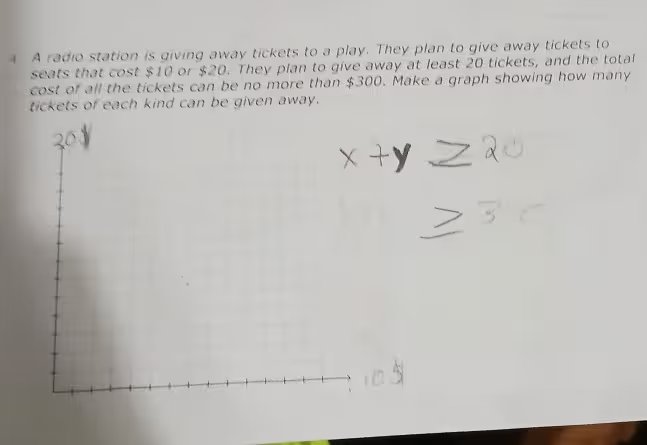
  • 4 A radio station is giving away tickets to a play. They plan to give away tickets to seats that cost 10 or 20. They plan to give away at least 20 tickets, and the total cost of all the tickets can be no more than $300. Make a graph showing how many tickets of each kind can be given away. x + y ≥ 20 10x + 20y ≤ 300

4 A radio station is giving away tickets to a play. They plan to give away tickets to seats that cost 10 or 20. They plan to give away at least 20 tickets, and the total cost of all the tickets can be no more than $300. Make a graph showing how many tickets of each kind can be given away. x + y ≥ 20 10x + 20y ≤ 300

4 A radio station is giving away tickets to a play. They plan to give away tickets to seats that cost 10 or 20. They plan to give away at least 20 tickets, and the total cost of all the tickets can be no more than $300. Make a graph showing how many tickets of each kind can be given away. x + y ≥ 20 10x + 20y ≤ 300

Answer

Answer: The solution involves graphing the system of inequalities: \( x + y \geq 20 \) and \( 10x + 20y \leq 300 \).

Explanation: This problem involves linear inequalities and requires graphing the feasible region that satisfies both conditions. The variables \( x \) and \( y \) represent the number of $10 and $20 tickets, respectively. The constraints are derived from the conditions given in the problem.

Steps:

  1. Identify the inequalities:
  • The total number of tickets should be at least 20:

\[ x + y \geq 20 \]

  • The total cost should not exceed $300:

\[ 10x + 20y \leq 300 \]

  1. Simplify the cost inequality:
  • Divide the entire inequality by 10:

\[ x + 2y \leq 30 \]

  1. Graph the inequalities:
  • For \( x + y \geq 20 \):
  • Rearrange to \( y \geq 20 - x \).
  • This line intersects the y-axis at (0, 20) and the x-axis at (20, 0).
  • For \( x + 2y \leq 30 \):
  • Rearrange to \( y \leq 15 - \frac{x}{2} \).
  • This line intersects the y-axis at (0, 15) and the x-axis at (30, 0).
  1. Determine the feasible region:
  • The feasible region is the area where the shaded regions of both inequalities overlap.
  • The vertices of the feasible region can be found by solving the system of equations formed by the lines:
  • \( x + y = 20 \)
  • \( x + 2y = 30 \)
  1. Solve the system of equations:
  • Subtract the first equation from the second:

\[ (x + 2y) - (x + y) = 30 - 20 \]

\[ y = 10 \]

  • Substitute \( y = 10 \) back into \( x + y = 20 \):

\[ x + 10 = 20 \Rightarrow x = 10 \]

  1. Vertices of the feasible region:
  • Intersection points: (10, 10), (0, 20), and (20, 0).
  1. Graph the region:
  • Plot the lines and shade the region that satisfies both inequalities.

This graph will show the combinations of $10 and $20 tickets that meet the conditions of the problem.

Related

(2) O3 + H → O2 + OH k2 = 1.78×10^-11 cm^3 s^-1 (3) O + OH → O2 + H k3 = 4.40×10^-11 cm^3 s^-1 (5) O + HO2 → O2 + OH k5 = 3.50×10^-11 cm^3 s^-1 (6) H + HO2 → O2 + H2 k6 = 5.40×10^-12 cm^3 s^-1 (9) OH + HO2 → O2 + H2O2 k9 = 4.00×10^-11 cm^3 s^-1 (10) HO2 + HO2 → O2 + H2O2 k10 = 2.50×10^-12 cm s^-1 (11) O + O2 + M → O3 + M k11 = 1.05×10^-34 cm^6 s^-1 (14) H + O2 + M → HO2 + M k14 = 8.08×10^-32 cm^6 s^-1 (15) H + H + M → H2O + M k15 = 3.31×10^-27 cm^6 s^-1 (16) O2 + hv → 2 O k16 = (1.26×10^-8 s^-1) φ (17) H2O + hv → H + OH k17 = (3.4×10^-6 s^-1) φ (18) O3 + hv → O2 + O k18 = (7.10×10^-5 s^-1) φ

Table 1 Reactions, rate constants and activation energies used in the model* No. Reaction kopt (M⁻¹ s⁻¹) 1 OH + H₂ → H + H₂O 3.74 x 10⁷ 2 OH + HO₂ → HO₂ + OH⁻ 5 x 10⁹ 3 OH + H₂O₂ → HO₂ + H₂O 3.8 x 10⁷ 4 OH + O₂ → O₂ + OH 9.96 x 10⁹ 5 OH + HO₂ → O₂ + H₂O 7.1 x 10⁹ 6 OH + OH → H₂O₂ 5.3 x 10⁹ 7 OH + e⁻aq → OH⁻ 3 x 10¹⁰ 8 H + O₂ → HO₂ 2.0 x 10¹⁰ 9 H + HO₂ → H₂O₂ 2.0 x 10¹⁰ 10 H + H₂O₂ → OH + H₂O 3.44 x 10⁷ 11 H + OH → H₂O 1.4 x 10¹⁰ 12 H + H → H₂ 1.94 x 10¹⁰ 13 e⁻aq + O₂ → O₂⁻ 1.9 x 10¹⁰ 14 e⁻aq + O₂ → HO₂⁻ + OH⁻ 1.3 x 10¹⁰ 15 e⁻aq + HO₂ 2.0 x 10¹⁰ 16 e⁻aq + H₂O₂ 1.1 x 10¹⁰ 17 e⁻aq + HO₂ → OH + OH⁻ 1.3 x 10¹⁰ 18 e⁻aq + H⁺ → H 2.3 x 10¹⁰ 19 e⁻aq + e⁻aq → H₂ + OH⁻ + OH⁻ 2.5 x 10⁹ 20 HO₂ + O₂ → O₂ + HO₂ 1.3 x 10⁹ 21 HO₂ + HO₂ → O₂ + H₂O₂ 8.3 x 10⁵ 22 HO₂ + HO₂ → O₂ + OH + H₂O 3.7 23 HO₂ + HO₂ → O₂ + O₂ + OH + H₂O 7 x 10⁵ s⁻¹ 24 H⁺ + O₂⁻ → HO₂ 4.5 x 10¹⁰ 25 H⁺ + O₂⁻ → O₂ 2.0 x 10¹⁰ 26 H⁺ + OH⁻ 1.4 x 10¹¹ 27 H⁺ + HO₂⁻ 2 x 10¹⁰ 28 H₂O₂ → HO₂ + H⁺ + OH⁻ 2.5 x 10⁻⁵ s⁻¹ 29 H₂O₂ → H⁺ + OH⁻ 1.4 x 10⁻⁷ s⁻¹ 30 O₂ + O₂ → O₂ + HO₂ + OH⁻ 0.3 31 O₂ + H₂O₂ → O₂ + OH + OH 16 32

(2) O3 + H → O2 + OH k2 = 1.78×10^-11 cm^3 s^-1 (3) O + OH → O2 + H k3 = 4.40×10^-11 cm^3 s^-1 (5) O + HO2 → O2 + OH k5 = 3.50×10^-11 cm^3 s^-1 (6) H2O + O → 2 OH k6 = 5.40×10^-12 cm^3 s^-1 (9) OH + HO2 → O2 + H2O k9 = 4.00×10^-11 cm^3 s^-1 (10) HO2 + HO2 → O2 + H2O2 k10 = 2.50×10^-12 cm s^-1 (11) O + O2 + M → O3 + M k11 = 1.05×10^-34 cm^6 s^-1 (14) H + O2 + M → HO2 + M k14 = 8.08×10^-32 cm^6 s^-1 (15) OH + H + M → H2O + M k15 = 3.31×10^-27 cm^6 s^-1 (16) O2 + hv → 2 O k16 = (1.26×10^-8 s^-1) φ (17) H2O + hv → H + OH k17 = (3.4×10^-6 s^-1) φ (18) O3 + hv → O2 + O k18 = (7.10×10^-8 s^-1) φ

Table 1 Reactions, rate constants and activation energies used in the model* No. Reaction kopt (M−1 s−1) 1 OH + H2 → H + H2O 3.74 x 10⁷ 2 OH + HO2 → HO2 + OH− 5 x 10⁹ 3 OH + H2O2 → HO2 + H2O 3.8 x 10⁷ 4 OH + O2 → O2− + OH 9.96 x 10⁹ 5 OH + HO2 → O2 + H2O 7.1 x 10⁹ 6 OH + OH → H2O2 5.3 x 10⁹ 7 OH + eaq− → OH− 3 x 10¹⁰ 8 OH + O2− → HO2 2.0 x 10¹⁰ 9 H + O2 → HO2 2.0 x 10¹⁰ 10 H + HO2 → H2O2 2.0 x 10¹⁰ 11 H + H2O2 → OH + H2O 3.4 x 10⁷ 12 H + OH → H2O 1.4 x 10¹⁰ 13 H + H → H2 7.9 x 10⁹ 14 eaq− + O2 → O2− 1.94 x 10¹⁰ 15 eaq− + O2− → HO2− + OH− 1.3 x 10¹⁰ 16 eaq− + HO2 → OH− + OH 2.5 x 10¹⁰ 17 eaq− + H2O2 → OH + OH− 1.3 x 10¹⁰ 18 eaq− + H → H− 2.5 x 10¹⁰ 19 eaq− + eaq− + H2 + OH− 3.5 x 10⁹ 20 eaq− + H2O2 + OH− 4.5 x 10⁹ 21 HO2 + O2 → O2 + HO2 3.7 22 HO2 + HO2 → O2 + H2O2 3.7 23 HO2 + HO2 → O2 + OH + H2O 7 x 10⁵ s−1 24 HO2− + O2 4.5 x 10¹⁰ 25 H2O2 → 2OH 0.035 s−1 26 H+ + O2− → HO2 2 x 10¹⁰ 27 H+ + HO2− → HO2 2 x 10¹⁰ 28 H2O2 → H+ + HO2− 2.5 x 10⁻⁵ s−1 29 H2O2 → H+ + HO2− 2.5 x 10⁻⁵ s−1 30 O2− + O2 → HO2 + OH− 0.3 31 O2− + H2O2 → O2 + OH− + OH 16 32 1.8 x 10⁷

(2) O3 + H → O2 + OH k2 = 1.78×10^-11 cm^3 s^-1 (3) O + OH → O2 + H k3 = 4.40×10^-11 cm^3 s^-1 (5) O + HO2 → O2 + OH k5 = 3.50×10^-11 cm^3 s^-1 (6) H2O → O + H2 k6 = 5.40×10^-12 cm^3 s^-1 (9) OH + HO2 → O2 + H2O k9 = 4.00×10^-11 cm^3 s^-1 (10) HO2 + HO2 → O2 + H2O2 k10 = 2.50×10^-12 cm s^-1 (11) O + O2 + M → O3 + M k11 = 1.05×10^-34 cm^6 s^-1 (14) H + O2 + M → HO2 + M k14 = 8.08×10^-32 cm^6 s^-1 (15) OH + H + M → H2O + M k15 = 3.31×10^-27 cm^6 s^-1 (16) O2 + hv → 2 O k16 = (1.26×10^-8 s^-1) φ (17) H2O + hv → H + OH k17 = (3.4×10^-6 s^-1) φ (18) O3 + hv → O2 + O k18 = (7.10×10^-8 s^-1) φ