
• Home /
  • Solution /
  • Math /
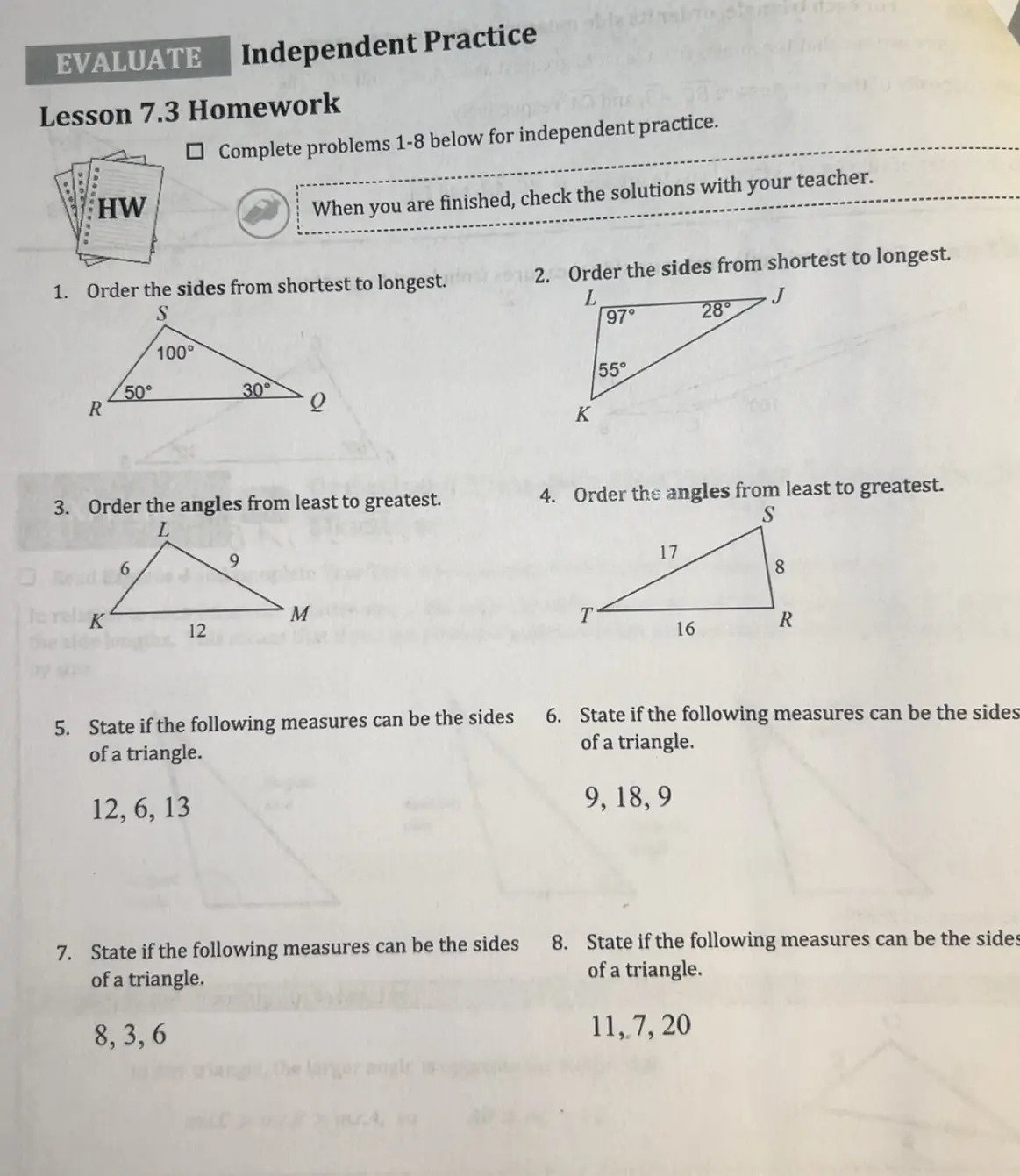
  • EVALUATE Independent Practice Lesson 7.3 Homework ☐ Complete problems 1-8 below for independent practice. When you are finished, check the solutions with your teacher. 1. Order the sides from shortest to longest. S 100° R 50° 30° Q 2. Order the sides from shortest to longest. L 97° 28° J 55° K 3. Order the angles from least to greatest. L 6 9 K M 12 4. Order the angles from least to greatest. S 17 T 8 16 R 5. State if the following measures can be the sides of a triangle. 12, 6, 13 6. State if the following measures can be the sides of a triangle. 9, 18, 9 7. State if the following measures can be the sides of a triangle. 8, 3, 6 8. State if the following measures can be the sides of a triangle. 11, 7, 20

EVALUATE Independent Practice Lesson 7.3 Homework ☐ Complete problems 1-8 below for independent practice. When you are finished, check the solutions with your teacher. 1. Order the sides from shortest to longest. S 100° R 50° 30° Q 2. Order the sides from shortest to longest. L 97° 28° J 55° K 3. Order the angles from least to greatest. L 6 9 K M 12 4. Order the angles from least to greatest. S 17 T 8 16 R 5. State if the following measures can be the sides of a triangle. 12, 6, 13 6. State if the following measures can be the sides of a triangle. 9, 18, 9 7. State if the following measures can be the sides of a triangle. 8, 3, 6 8. State if the following measures can be the sides of a triangle. 11, 7, 20

EVALUATE Independent Practice Lesson 7.3 Homework ☐ Complete problems 1-8 below for independent practice. When you are finished, check the solutions with your teacher. 1. Order the sides from shortest to longest. S 100° R 50° 30° Q 2. Order the sides from shortest to longest. L 97° 28° J 55° K 3. Order the angles from least to greatest. L 6 9 K M 12 4. Order the angles from least to greatest. S 17 T 8 16 R 5. State if the following measures can be the sides of a triangle. 12, 6, 13 6. State if the following measures can be the sides of a triangle. 9, 18, 9 7. State if the following measures can be the sides of a triangle. 8, 3, 6 8. State if the following measures can be the sides of a triangle. 11, 7, 20

Answer

Answer:

  1. \( \overline{RQ}, \overline{SQ}, \overline{RS} \)
  2. \( \overline{KJ}, \overline{KL}, \overline{LJ} \)
  3. \( \angle K, \angle L, \angle M \)
  4. \( \angle R, \angle S, \angle T \)
  5. Yes
  6. No
  7. No
  8. No

Explanation:

  1. Triangle Inequality Theorem: The sides opposite the smallest angles are the shortest.
  2. Triangle Inequality Theorem: The sides opposite the smallest angles are the shortest.
  3. Triangle Inequality Theorem: The smallest angle is opposite the shortest side.
  4. Triangle Inequality Theorem: The smallest angle is opposite the shortest side.

5-8. Triangle Inequality Theorem: The sum of the lengths of any two sides must be greater than the length of the third side.

Steps:

  1. Order the sides from shortest to longest:
  • Given angles: \( \angle R = 50^\circ \), \( \angle S = 100^\circ \), \( \angle Q = 30^\circ \).
  • Shortest side is opposite the smallest angle: \( \overline{RQ} \).
  • Next is \( \overline{SQ} \) opposite \( \angle R \).
  • Longest is \( \overline{RS} \) opposite \( \angle S \).
  1. Order the sides from shortest to longest:
  • Given angles: \( \angle L = 97^\circ \), \( \angle J = 28^\circ \), \( \angle K = 55^\circ \).
  • Shortest side is opposite the smallest angle: \( \overline{KJ} \).
  • Next is \( \overline{KL} \) opposite \( \angle K \).
  • Longest is \( \overline{LJ} \) opposite \( \angle L \).
  1. Order the angles from least to greatest:
  • Given sides: \( \overline{KL} = 6 \), \( \overline{LM} = 9 \), \( \overline{KM} = 12 \).
  • Smallest angle is opposite the shortest side: \( \angle K \).
  • Next is \( \angle L \) opposite \( \overline{LM} \).
  • Largest is \( \angle M \) opposite \( \overline{KM} \).
  1. Order the angles from least to greatest:
  • Given sides: \( \overline{TR} = 8 \), \( \overline{RS} = 17 \), \( \overline{TS} = 16 \).
  • Smallest angle is opposite the shortest side: \( \angle R \).
  • Next is \( \angle S \) opposite \( \overline{TS} \).
  • Largest is \( \angle T \) opposite \( \overline{RS} \).
  1. State if the measures can be the sides of a triangle:
  • Sides: 12, 6, 13.
  • Check: \( 12 + 6 > 13 \), \( 12 + 13 > 6 \), \( 6 + 13 > 12 \).
  • All conditions satisfied: Yes.
  1. State if the measures can be the sides of a triangle:
  • Sides: 9, 18, 9.
  • Check: \( 9 + 9 > 18 \) (False).
  • Condition not satisfied: No.
  1. State if the measures can be the sides of a triangle:
  • Sides: 8, 3, 6.
  • Check: \( 8 + 3 > 6 \), \( 8 + 6 > 3 \), \( 3 + 6 > 8 \) (False).
  • Condition not satisfied: No.
  1. State if the measures can be the sides of a triangle:
  • Sides: 11, 7, 20.
  • Check: \( 11 + 7 > 20 \) (False).
  • Condition not satisfied: No.

Related

(2) O3 + H → O2 + OH k2 = 1.78×10^-11 cm^3 s^-1 (3) O + OH → O2 + H k3 = 4.40×10^-11 cm^3 s^-1 (5) O + HO2 → O2 + OH k5 = 3.50×10^-11 cm^3 s^-1 (6) H + HO2 → O2 + H2 k6 = 5.40×10^-12 cm^3 s^-1 (9) OH + HO2 → O2 + H2O2 k9 = 4.00×10^-11 cm^3 s^-1 (10) HO2 + HO2 → O2 + H2O2 k10 = 2.50×10^-12 cm s^-1 (11) O + O2 + M → O3 + M k11 = 1.05×10^-34 cm^6 s^-1 (14) H + O2 + M → HO2 + M k14 = 8.08×10^-32 cm^6 s^-1 (15) H + H + M → H2O + M k15 = 3.31×10^-27 cm^6 s^-1 (16) O2 + hv → 2 O k16 = (1.26×10^-8 s^-1) φ (17) H2O + hv → H + OH k17 = (3.4×10^-6 s^-1) φ (18) O3 + hv → O2 + O k18 = (7.10×10^-5 s^-1) φ

Table 1 Reactions, rate constants and activation energies used in the model* No. Reaction kopt (M⁻¹ s⁻¹) 1 OH + H₂ → H + H₂O 3.74 x 10⁷ 2 OH + HO₂ → HO₂ + OH⁻ 5 x 10⁹ 3 OH + H₂O₂ → HO₂ + H₂O 3.8 x 10⁷ 4 OH + O₂ → O₂ + OH 9.96 x 10⁹ 5 OH + HO₂ → O₂ + H₂O 7.1 x 10⁹ 6 OH + OH → H₂O₂ 5.3 x 10⁹ 7 OH + e⁻aq → OH⁻ 3 x 10¹⁰ 8 H + O₂ → HO₂ 2.0 x 10¹⁰ 9 H + HO₂ → H₂O₂ 2.0 x 10¹⁰ 10 H + H₂O₂ → OH + H₂O 3.44 x 10⁷ 11 H + OH → H₂O 1.4 x 10¹⁰ 12 H + H → H₂ 1.94 x 10¹⁰ 13 e⁻aq + O₂ → O₂⁻ 1.9 x 10¹⁰ 14 e⁻aq + O₂ → HO₂⁻ + OH⁻ 1.3 x 10¹⁰ 15 e⁻aq + HO₂ 2.0 x 10¹⁰ 16 e⁻aq + H₂O₂ 1.1 x 10¹⁰ 17 e⁻aq + HO₂ → OH + OH⁻ 1.3 x 10¹⁰ 18 e⁻aq + H⁺ → H 2.3 x 10¹⁰ 19 e⁻aq + e⁻aq → H₂ + OH⁻ + OH⁻ 2.5 x 10⁹ 20 HO₂ + O₂ → O₂ + HO₂ 1.3 x 10⁹ 21 HO₂ + HO₂ → O₂ + H₂O₂ 8.3 x 10⁵ 22 HO₂ + HO₂ → O₂ + OH + H₂O 3.7 23 HO₂ + HO₂ → O₂ + O₂ + OH + H₂O 7 x 10⁵ s⁻¹ 24 H⁺ + O₂⁻ → HO₂ 4.5 x 10¹⁰ 25 H⁺ + O₂⁻ → O₂ 2.0 x 10¹⁰ 26 H⁺ + OH⁻ 1.4 x 10¹¹ 27 H⁺ + HO₂⁻ 2 x 10¹⁰ 28 H₂O₂ → HO₂ + H⁺ + OH⁻ 2.5 x 10⁻⁵ s⁻¹ 29 H₂O₂ → H⁺ + OH⁻ 1.4 x 10⁻⁷ s⁻¹ 30 O₂ + O₂ → O₂ + HO₂ + OH⁻ 0.3 31 O₂ + H₂O₂ → O₂ + OH + OH 16 32

(2) O3 + H → O2 + OH k2 = 1.78×10^-11 cm^3 s^-1 (3) O + OH → O2 + H k3 = 4.40×10^-11 cm^3 s^-1 (5) O + HO2 → O2 + OH k5 = 3.50×10^-11 cm^3 s^-1 (6) H2O + O → 2 OH k6 = 5.40×10^-12 cm^3 s^-1 (9) OH + HO2 → O2 + H2O k9 = 4.00×10^-11 cm^3 s^-1 (10) HO2 + HO2 → O2 + H2O2 k10 = 2.50×10^-12 cm s^-1 (11) O + O2 + M → O3 + M k11 = 1.05×10^-34 cm^6 s^-1 (14) H + O2 + M → HO2 + M k14 = 8.08×10^-32 cm^6 s^-1 (15) OH + H + M → H2O + M k15 = 3.31×10^-27 cm^6 s^-1 (16) O2 + hv → 2 O k16 = (1.26×10^-8 s^-1) φ (17) H2O + hv → H + OH k17 = (3.4×10^-6 s^-1) φ (18) O3 + hv → O2 + O k18 = (7.10×10^-8 s^-1) φ

Table 1 Reactions, rate constants and activation energies used in the model* No. Reaction kopt (M−1 s−1) 1 OH + H2 → H + H2O 3.74 x 10⁷ 2 OH + HO2 → HO2 + OH− 5 x 10⁹ 3 OH + H2O2 → HO2 + H2O 3.8 x 10⁷ 4 OH + O2 → O2− + OH 9.96 x 10⁹ 5 OH + HO2 → O2 + H2O 7.1 x 10⁹ 6 OH + OH → H2O2 5.3 x 10⁹ 7 OH + eaq− → OH− 3 x 10¹⁰ 8 OH + O2− → HO2 2.0 x 10¹⁰ 9 H + O2 → HO2 2.0 x 10¹⁰ 10 H + HO2 → H2O2 2.0 x 10¹⁰ 11 H + H2O2 → OH + H2O 3.4 x 10⁷ 12 H + OH → H2O 1.4 x 10¹⁰ 13 H + H → H2 7.9 x 10⁹ 14 eaq− + O2 → O2− 1.94 x 10¹⁰ 15 eaq− + O2− → HO2− + OH− 1.3 x 10¹⁰ 16 eaq− + HO2 → OH− + OH 2.5 x 10¹⁰ 17 eaq− + H2O2 → OH + OH− 1.3 x 10¹⁰ 18 eaq− + H → H− 2.5 x 10¹⁰ 19 eaq− + eaq− + H2 + OH− 3.5 x 10⁹ 20 eaq− + H2O2 + OH− 4.5 x 10⁹ 21 HO2 + O2 → O2 + HO2 3.7 22 HO2 + HO2 → O2 + H2O2 3.7 23 HO2 + HO2 → O2 + OH + H2O 7 x 10⁵ s−1 24 HO2− + O2 4.5 x 10¹⁰ 25 H2O2 → 2OH 0.035 s−1 26 H+ + O2− → HO2 2 x 10¹⁰ 27 H+ + HO2− → HO2 2 x 10¹⁰ 28 H2O2 → H+ + HO2− 2.5 x 10⁻⁵ s−1 29 H2O2 → H+ + HO2− 2.5 x 10⁻⁵ s−1 30 O2− + O2 → HO2 + OH− 0.3 31 O2− + H2O2 → O2 + OH− + OH 16 32 1.8 x 10⁷

(2) O3 + H → O2 + OH k2 = 1.78×10^-11 cm^3 s^-1 (3) O + OH → O2 + H k3 = 4.40×10^-11 cm^3 s^-1 (5) O + HO2 → O2 + OH k5 = 3.50×10^-11 cm^3 s^-1 (6) H2O → O + H2 k6 = 5.40×10^-12 cm^3 s^-1 (9) OH + HO2 → O2 + H2O k9 = 4.00×10^-11 cm^3 s^-1 (10) HO2 + HO2 → O2 + H2O2 k10 = 2.50×10^-12 cm s^-1 (11) O + O2 + M → O3 + M k11 = 1.05×10^-34 cm^6 s^-1 (14) H + O2 + M → HO2 + M k14 = 8.08×10^-32 cm^6 s^-1 (15) OH + H + M → H2O + M k15 = 3.31×10^-27 cm^6 s^-1 (16) O2 + hv → 2 O k16 = (1.26×10^-8 s^-1) φ (17) H2O + hv → H + OH k17 = (3.4×10^-6 s^-1) φ (18) O3 + hv → O2 + O k18 = (7.10×10^-8 s^-1) φ