
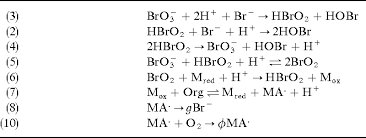
Answer: The image shows a series of chemical reactions, likely part of a mechanism for a chemical process. These reactions involve bromate (\( \text{BrO}_3^- \)), bromous acid (\( \text{HBrO}_2 \)), and other species, indicating a redox process, possibly the Belousov-Zhabotinsky (BZ) reaction.
Explanation: The reactions in the image are part of a complex oscillating chemical system. The BZ reaction is a classical example of non-equilibrium thermodynamics, involving periodic changes in concentration of reactants and products. It typically involves bromate ions, bromide ions, and an organic substrate, often in an acidic medium. Key concepts include:
- Redox Reactions: Involves oxidation and reduction processes.
- Oscillating Reactions: Chemical reactions where the concentration of reactants and products periodically change.
- Radical Intermediates: Species like \( \text{MA}^\cdot \) indicate radical intermediates, which are common in chain reactions.
Steps:
- Reaction (3):
- Concept: Formation of bromous acid and hypobromous acid from bromate and bromide.
- Reaction (4):
- Concept: Further reaction of bromous acid with bromide to form hypobromous acid.
- Reaction (5):
- Concept: Disproportionation of bromous acid.
- Reaction (6):
- Concept: Formation of bromine dioxide from bromate and bromous acid.
- Reaction (7):
- Concept: Redox reaction involving a metal catalyst.
- Reaction (8):
- Concept: Oxidation of an organic substrate, forming a radical.
- Reaction (9):
- Concept: Radical reaction leading to bromide formation.
- Reaction (10):
- Concept: Reaction of the radical with oxygen, possibly indicating a chain propagation step.
These reactions collectively describe a complex oscillating chemical system, showcasing the interplay of redox chemistry, radical intermediates, and catalytic processes.