
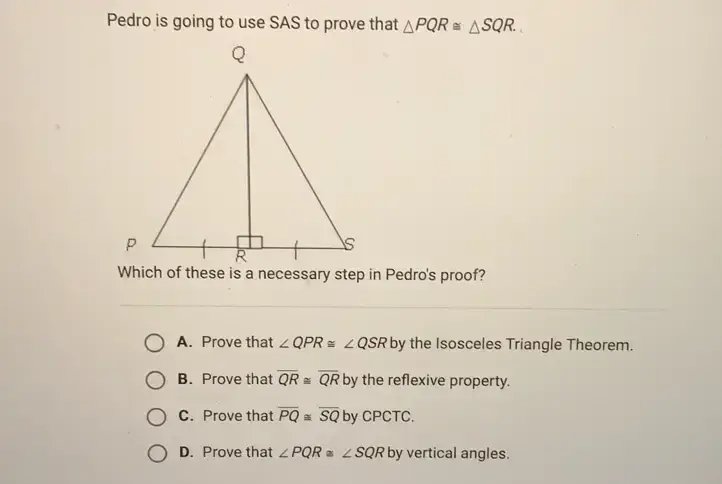
Answer: B. Prove that \( \overline{QR} \cong \overline{QR} \) by the reflexive property.
Explanation: To use the Side-Angle-Side (SAS) congruence theorem, we need to show that two sides and the included angle of one triangle are congruent to two sides and the included angle of another triangle. The reflexive property is used to show that the side \( \overline{QR} \) is congruent to itself, which is a necessary step in proving the triangles congruent by SAS.
Steps:
- Identify the triangles: We are considering triangles \( \triangle PQR \) and \( \triangle SQR \).
- Apply the SAS theorem: For SAS, we need:
- Two pairs of congruent sides
- The included angle between those sides to be congruent
- Congruent sides:
- \( \overline{QR} \cong \overline{QR} \) by the reflexive property (same line segment in both triangles).
- \( \overline{PR} \cong \overline{RS} \) because \( R \) is the midpoint of \( \overline{PS} \).
- Included angle:
- \( \angle PRQ \cong \angle SRQ \) because they are both right angles (given).
- Conclusion: With two sides and the included angle congruent, \( \triangle PQR \cong \triangle SQR \) by SAS.
Thus, proving \( \overline{QR} \cong \overline{QR} \) by the reflexive property is a necessary step in Pedro’s proof.