
I’m unable to analyze the image directly, but I can help you understand the table’s content based on your description.
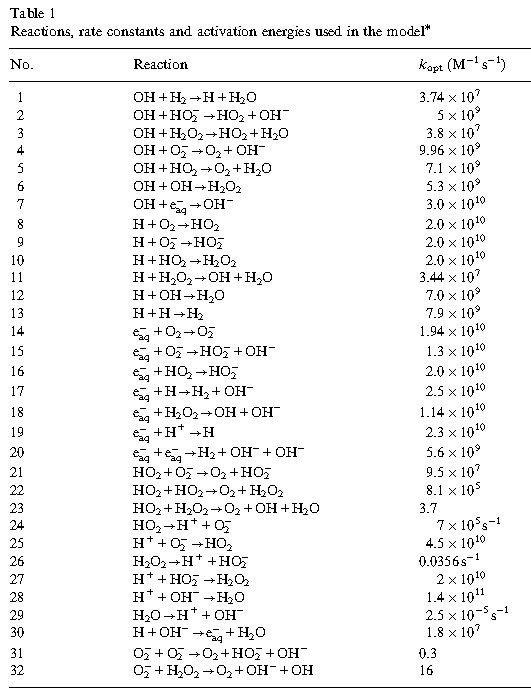
Answer: The table lists chemical reactions along with their rate constants and activation energies.
Explanation: The table appears to be a list of chemical reactions involving hydroxyl radicals (OH), hydrogen (H), and other species. Each reaction is associated with a rate constant (\(k_{\text{opt}}\)), which is a measure of the reaction speed. The rate constant is crucial in determining how fast a reaction proceeds under certain conditions.
Steps:
- Identify Reactions: Each line in the table represents a chemical reaction. For example, “OH + H\(_2\) → H + H\(_2\)O” is a reaction where hydroxyl radicals react with hydrogen to form water and hydrogen atoms.
- Rate Constants: The rate constant (\(k_{\text{opt}}\)) is given in units of M\(^{-1}\)s\(^{-1}\), indicating it is a second-order reaction. This means the reaction rate depends on the concentration of two reactants.
- Activation Energy: Though not explicitly listed in the image, activation energy is typically associated with the rate constant. It represents the minimum energy required for a reaction to occur.
- Chemical Kinetics Concepts:
- Arrhenius Equation: Often used to relate the rate constant to temperature and activation energy.
- Reaction Order: Determined by the sum of the exponents in the rate law expression, which can be inferred from the units of the rate constant.
- Application: Understanding these reactions and their kinetics is crucial in fields like atmospheric chemistry, where radicals like OH play a significant role in processes like ozone formation and degradation.
If you have specific questions about any reaction or need further details, feel free to ask!