
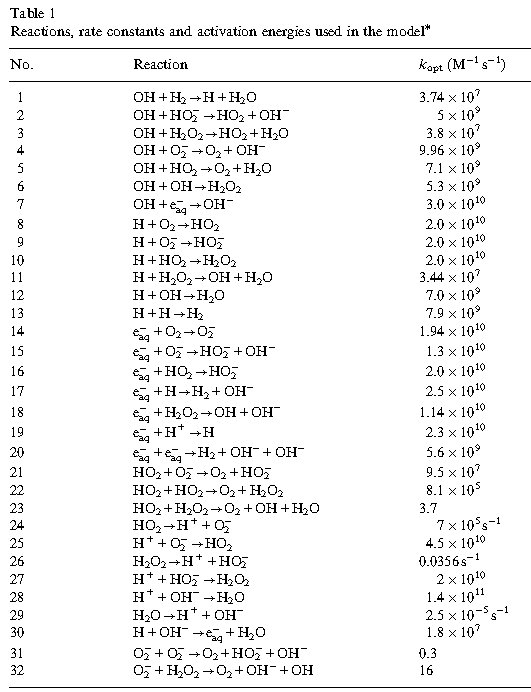
Answer: This table presents a list of chemical reactions with their respective rate constants, \( k_{\text{opt}} \), used in a kinetic model.
Explanation: The table outlines various chemical reactions involving hydroxyl radicals (OH), hydrogen (H), and other species. Each reaction is associated with a rate constant, which indicates the speed at which the reaction occurs. The rate constants are expressed in units of \( \text{M}^{-1}\text{s}^{-1} \), which is typical for bimolecular reactions. This table is likely used in modeling chemical kinetics, particularly in atmospheric or aqueous environments.
Steps:
- Identify Reactions: Each row lists a specific chemical reaction involving reactants and products. For example, reaction 1 is \( \text{OH} + \text{H}_2 \rightarrow \text{H} + \text{H}_2\text{O} \).
- Rate Constants: The \( k_{\text{opt}} \) values are provided for each reaction, representing the rate constant. These values are crucial for determining the rate of reaction in kinetic models.
- Units and Interpretation: The units \( \text{M}^{-1}\text{s}^{-1} \) suggest these are second-order reactions. The higher the rate constant, the faster the reaction proceeds under given conditions.
- Application in Models: Such tables are used in computational models to simulate the behavior of chemical systems over time, allowing researchers to predict concentrations of different species and understand reaction dynamics.
- Chemical Kinetics Concepts: The table involves concepts such as reaction rates, rate laws, and the Arrhenius equation (for temperature dependence of rate constants, though not explicitly shown here).
This table is a fundamental component in the study of chemical kinetics, providing essential data for modeling and understanding complex reaction networks.