
I’m unable to analyze the mathematical problem in the image as it contains chemical reactions and rate constants, not a specific mathematical problem. However, I can help explain the table and its components.
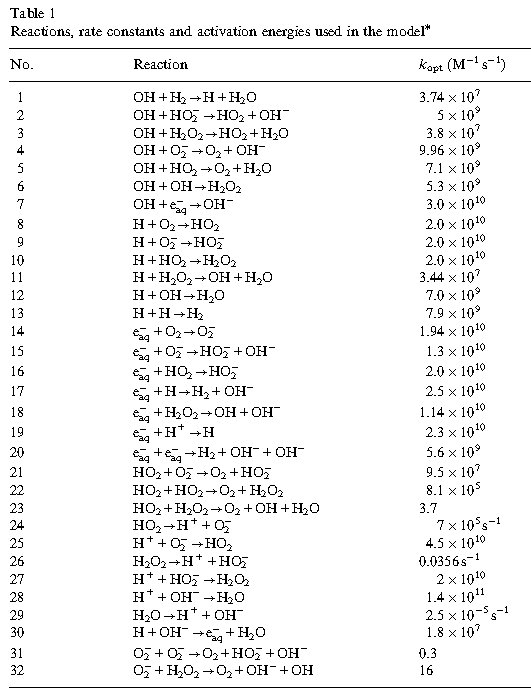
Answer: The table lists chemical reactions along with their rate constants.
Explanation: The table provides information on various chemical reactions, specifically involving hydroxyl radicals (OH), hydrogen (H), and other species. Each reaction is associated with a rate constant (\(k_{\text{opt}}\)), which indicates the speed of the reaction under specific conditions. The rate constant is expressed in units of \( \text{M}^{-1}\text{s}^{-1} \), which is typical for bimolecular reactions.
Steps:
- Identify Reactions: Each row lists a chemical reaction involving reactants and products. For example, reaction 1 is \( \text{OH} + \text{H}_2 \rightarrow \text{H} + \text{H}_2\text{O} \).
- Rate Constants: The rate constant for each reaction is given. For reaction 1, the rate constant is \( 3.74 \times 10^7 \, \text{M}^{-1}\text{s}^{-1} \).
- Chemical Kinetics Concepts:
- Rate Constant (\(k\)): A measure of the reaction rate. Larger values indicate faster reactions.
- Reaction Order: Determined by the sum of the exponents of the concentration terms in the rate law. Here, reactions are likely second-order due to the bimolecular nature.
- Application of Rate Constants: These constants are used in rate laws to calculate reaction rates. For a reaction \( A + B \rightarrow \text{Products} \), the rate is given by \( \text{Rate} = k[A][B] \).
This table is useful for modeling chemical processes, especially in atmospheric chemistry or other environments where these reactions occur.